Vehicle crossing permits in East Gippsland: a Bairnsdale guide
Your new driveway stops at your boundary. The strip between there and the road belongs to the public, and in East Gippsland building across it needs Shire consent. This guide explains how that works around Bairnsdale and what a good crossing involves.
Email: info@bairnsdaleconcreting.com.au
What counts as a vehicle crossing
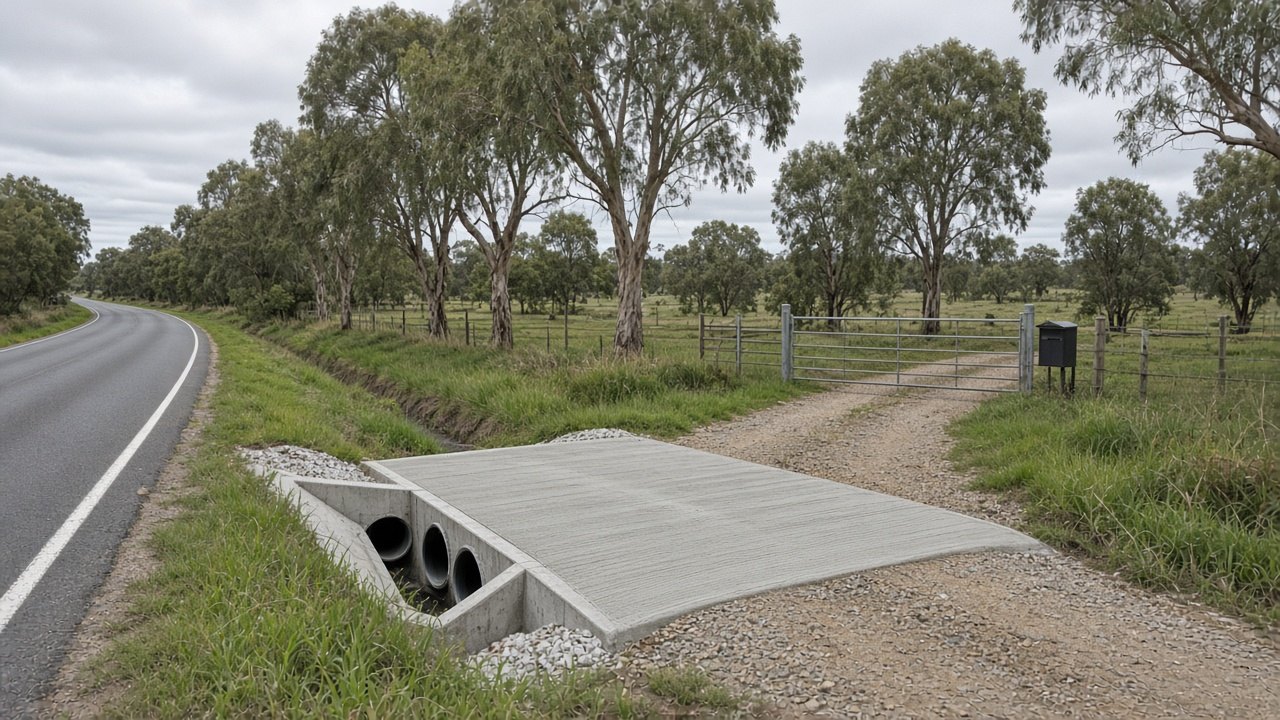
A vehicle crossing is the section of driveway that runs from your property line, over the nature strip and any footpath, to the edge of the road. In town it usually meets a kerb and channel; in rural areas it often spans a table drain on a pipe culvert. Because it sits in the road reserve, the Shire controls where it goes, how wide it is, what it is built from and how it drains.
Who gives consent
For local roads, East Gippsland Shire Council issues consent for works within the road reserve, including new, widened or replaced crossings. Where the crossing meets a state-managed road such as the Princes Highway through Bairnsdale or the Great Alpine Road toward Bruthen, the Department of Transport and Planning has the say, and access onto those roads is assessed more strictly. Your concreter should know which authority applies before giving you a start date.
Kerbed streets in town
In Bairnsdale, Paynesville and Lakes Entrance streets with kerb and channel, a new crossing normally means saw-cutting the existing kerb, laying a crossover or layback kerb, rebuilding the footpath to match levels and pouring the crossing to the Shire's standard thickness and finish. Plain broom-finished concrete is the usual requirement so footpath users get a consistent, non-slip surface; decorative finishes generally start at your boundary.
Rural crossings and culverts
On roads with open table drains around Lindenow, Bruthen, Nicholson and Orbost, a crossing needs a pipe culvert big enough to carry storm flows, with concrete endwalls or headwalls to stop the drain scouring around it. The pipe size, length, cover and endwall type are set by the Shire. Getting this right matters: an undersized culvert blocks in the first big east coast low and floods the road or your entrance.
Services, trees and sight lines
Nature strips carry water mains, sewer, gas, power, telecommunications and stormwater. We arrange service location before any digging. The Shire also sets clearances from street trees, power poles, pits and intersections, and will look at sight distance where a crossing joins a busy road or sits on a bend or crest, as many do on the hilly streets of Lakes Entrance and Metung.
Widening or replacing an old crossing
Plenty of older crossings around Bairnsdale are narrow, cracked or sunk. Widening for a second car, a caravan or a boat trailer, or replacing a broken crossing, still needs consent. Doing the crossing at the same time as a new driveway keeps levels and joints lined up and usually saves a second set-up.
Inspections and handover
Depending on the job, the Shire may want to inspect formwork or the subgrade before the pour and the finished crossing afterwards. We book those inspections, keep the paperwork and leave the site safe for pedestrians while the concrete cures.
Questions to ask before you sign
Who is applying for the consent and is it included in the quote? What thickness and finish will the crossing be? Is the kerb being replaced or cut? For rural sites, what pipe size and endwalls are allowed? Who books the inspections? A concreter who answers those clearly is one who has done it before.
Talk to a Bairnsdale concreter
Free site visits from Bairnsdale out to Paynesville, Lakes Entrance, Bruthen and Orbost. You will not see rates on this site; East Gippsland soils, demolition and truck reach make each quote its own.